BPS Screener Explained: How It Reads the Market and Surfaces Trade Candidates
The BPS Screener automatically detects market regime from VIX, selects the right parameter set, and outputs ranked spread candidates with probability data. Here's exactly how it works.
Current status: The BPS Screener currently runs as a daily email report. Full in-app access is coming in BPS Tracker v1.3. If you want to use it the moment it launches, download BPS Tracker now — it'll be available automatically after the update.
Every trading day, the BPS Screener runs a multi-step pipeline: it reads the VIX, classifies the market regime, selects the right spread parameters, scans hundreds of options chains, and delivers a ranked list of candidates — with probability data baked in.
This article walks through a real screener report and explains what every number means.
Step 1: Market Regime Detection
The screener starts by reading VIX — the market's implied volatility gauge.
| VIX Level | Regime | Approach |
|---|---|---|
| Low | LOW | Conservative — tighter spreads, smaller delta |
| Moderate | MID | Balanced — standard spread width |
| Elevated | HIGH | Aggressive — wider DTE, more premium available |
In the report above, VIX was 27.10 → HIGH regime → param set D4_W2_SB2 was selected automatically. No manual adjustment needed.
The logic is simple: when volatility spikes, options premiums are richer, so you can afford to go further out-of-the-money and still collect meaningful credit. The parameter set adapts accordingly.
Step 2: Parameter Selection
Under HIGH regime, the screener uses:
- DTE ~35: 35 days to expiration
- Width $5: $5-wide spreads
- 7 contracts: position sizing per candidate
- Delta range: short put delta range, tuned per regime
These aren't arbitrary numbers — they're tuned against historical data to balance win rate against average credit collected.
Reading the Screener Report
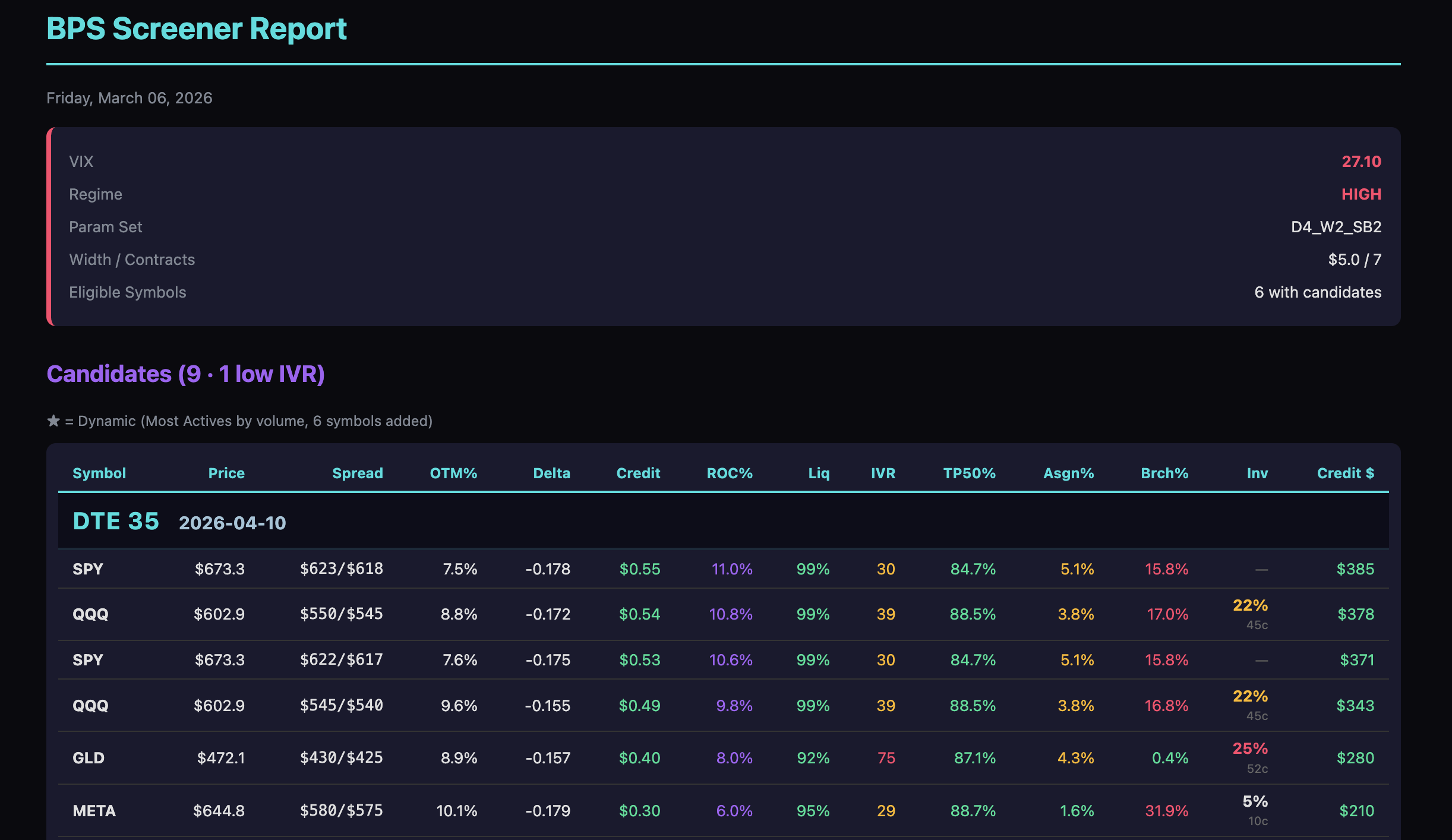
The report surfaces 9 candidates across 6 eligible symbols.
The Columns Explained
Symbol / Price / Spread
The underlying, its current price, and the specific strikes. $623/$618 means sell the $623 Put, buy the $618 Put.
OTM%
How far out-of-the-money the short put is. 7.5% means the short strike is 7.5% below the current price. Higher OTM% = more buffer before the trade goes wrong.
Delta
The short put's delta — a proxy for probability of going in-the-money. -0.178 means roughly 17.8% chance the short strike is breached at expiration.
Credit / Credit $
Premium collected. $0.55 per share = $385 for 7 contracts of a $5-wide spread. This is your maximum profit.
ROC%
Return on Capital. Credit ÷ (Width − Credit) × 100. An 11% ROC% means you earn 11% on the capital at risk for this trade.
Liq Liquidity score (0–100). Values near 99% indicate very tight bid-ask spreads — fills close to mid are realistic.
IVR
IV Rank — where current implied volatility sits relative to the past 365 days. Higher = richer premiums. The 1 low IVR note in the header flags candidates below the preferred threshold.
TP50%
Probability of reaching 50% profit target before expiration (Monte Carlo simulation). 84.7% means 8-in-10 chance the trade hits your profit target early.
Asgn% Early assignment probability for the short put. Values under 5% indicate low risk of being assigned before expiration.
Brch%
Breach probability — probability that the short strike is tested at any point before expiration (not just at expiry). More conservative than delta alone. 15.8% means roughly 1-in-6 chance of a scare, even if the trade ultimately expires worthless.
Inv
Inventory — existing position size. 22% / 45c means you already hold 22% of your max allocation in QQQ. This prevents over-concentration.
Picking a Trade from the Candidates
Candidates are already ranked by ROC%. Before entering, verify:
- IVR ≥ 30 — avoid low-IVR candidates (flagged in the header)
- Brch% ≤ 20% — keeps breach risk manageable in HIGH regime
- Inv is blank or low — don't over-concentrate in one symbol
- Liq ≥ 90% — ensures clean fills
In the report above, the top SPY and QQQ entries check all boxes. GLD at IVR 75 is particularly attractive — high IV, very low Brch%, minimal assignment risk.
Why Automate This?
Manually scanning options chains for 70+ symbols, computing Greeks, running Monte Carlo, and cross-checking against existing inventory takes 30–60 minutes per day. The screener compresses this into ~27 seconds and delivers the output to your inbox before market open.
The human decision is still yours. The screener just makes sure you're not missing the best setup of the day.
Frequently Asked Questions
- How does the BPS Screener select trade candidates?
- The Screener first reads VIX to classify the market regime (LOW/MID/HIGH), then automatically selects the matching parameter set (DTE, spread width, delta range), scans hundreds of options chains, and ranks candidates by Return on Capital.
- What does TP50% mean in the BPS Screener report?
- TP50% is the probability of reaching the 50% profit target before expiration, calculated via Monte Carlo simulation. A value of 84.7% means roughly 8-in-10 trades are expected to hit the profit target early.
- What is Brch% in options screening?
- Brch% (Breach probability) is the probability that the short strike gets tested at any point before expiration — not just at expiry. It's more conservative than Delta alone. Values under 20% are generally acceptable for HIGH-regime trades.
- How long does the BPS Screener take to run?
- The screener compresses what would be 30–60 minutes of manual scanning across 70+ symbols into approximately 27 seconds, delivering ranked candidates with probability data before market open.
Ready to track your BPS positions?
BPS Tracker gives you real-time Greeks, IV Rank, and AI analysis — trade with data.
Download on App Store — Free